This year we are testing the soil in various places on the land and also testing for biodiversity. The idea is to provide us with a base line measurement from which to measure over the coming years the improvement in both aspects.
History
Lavandeira, up to 35 years ago, was mainly covered in apple trees. Because of the long and narrow terraces, the harvesting of apples became unprofitable due to the difficulty of getting machines onto the land and the lack of manual labour in the region. This area of Portugal, like many agricultural areas, suffered many waves of migraton to the cities and other countries. The owner of the land cut the apple trees and planted over 5,000 pine trees for timber. Sadly, the worst fire in the history of the area, in October 2017, burned all the pines. From this time to March 2024, almost 7 years, the land was left untouched to be taken over by Scotch Broom, a pioneer species and nitrogen fixer. When I bought the land my first action was to bring in a mulching machine to take down the 3.5m broom that covered over 50% of the 8 hectares of land. Indeed, when I took the decision to buy the land, I was unable to walk on most of the land or even visit the two ruins and the river, the broom was so impenetrable.
Land types
There are three different areas of land on Lavandeira, the terraces (3 hectares, very limited erosion, no broom and soil untouched for over 30 years), unterraced flat land of 3 hectares covered with broom and steep forested land of 2 hectares also covered with broom that slopes down sharply to the river.
Below is an image of the land and the three areas mentioned:
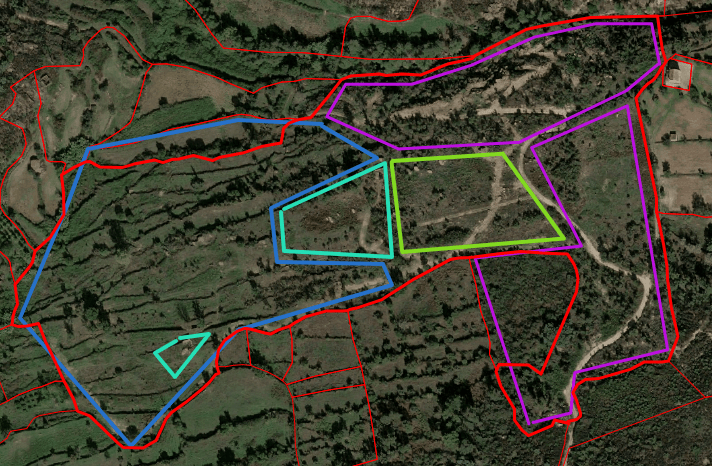
Purple zones = Forest zones where we will mainly focus on creating diversified forests with some productive trees such as Stone Pine and Chestnut.
Green zone = Main focus for regenerative food production
Turquoise zones = Living areas
Blue zone = Fertile terrace zones including Little Palestine and Nut Forest and later development of syntropic productive planting.
 Back to my roots